“Do the noise for us.”
That was a running gag on NPR’s Car Talk, where the Magliozzi brothers from Boston diagnosed car problems based on callers trying to imitate the sounds their vehicles made. “Is it more of a ‘click-click-click’ or a ‘thunk-thunk-thunk’?” they’d ask, somehow extracting diagnostic gold from amateur sound effects over the phone.
The sounds your motor makes can indicate what’s failing inside if you know how to listen. Electrical problems sound different from mechanical ones, and knowing the difference can help you figure out how to respond.
At Independent Electric, we’ve spent over 100 years listening to healthy motors, struggling motors, and motors that are about to give up entirely. Let’s walk through how to use your ears as diagnostic tools and why distinguishing electrical from mechanical noise can save you thousands in repair costs.
Why the Distinction Matters
Electrical and mechanical problems require different responses. When you hear electrical noise (humming, ringing, arcing), you’re dealing with winding issues, phase imbalances, or insulation breakdown. These problems need electrical testing (like PdMA) to be diagnosed properly. The fix typically involves rewinding or addressing power quality issues.
Mechanical noise signals bearing wear, misalignment, or rotor problems. These need vibration analysis to pinpoint the issue. The fix might be bearing replacement, alignment correction, or balancing—all mechanical interventions.
Here’s what makes this critical: most motors fail because of mechanical issues. When bearings fail completely, the rotor drops and starts dragging on the stator iron, which then blows up the winding. You start with a bearing problem (mechanical) that destroys your windings (electrical). By the time you hear electrical arcing or smell burning insulation, what started as a $500 bearing replacement may have become a $5,000 rewind.
Catching mechanical noise early, when it’s still just mechanical, can not only save your motor’s electrical system; it can also save you big bucks.
What Electrical Problems Sound Like
The High-Pitched Ring
Electrical issues often create a high-pitched ringing sound that one of our senior technicians describes as “like your ears ringing or just a constant ‘eeee’ sound.” This ringing typically indicates problems with the winding or electrical imbalances between phases.
The “Wah-Wah” Sound
Another electrical signature is what we call the “wah-wah” sound—a wavering, oscillating hum that changes pitch rhythmically. This sound usually means something’s out of order electrically. The only way to know for sure is to start testing with PdMA equipment.
Arcing and Crackling
If you hear crackling, popping, or what sounds like electrical arcing, pay attention immediately. DC motors, especially, can develop audible arcing as brushes wear or connections degrade. Any arcing sound means insulation has failed somewhere, and current is finding unintended paths.
Humming That Changes
All motors hum to some degree, and that’s normal. But when the character of that hum changes—when it gets louder or the pitch shifts—that’s your warning sign. A healthy motor maintains a consistent hum at its operating frequency.
What Mechanical Problems Sound Like
Knocking and Thumping
Mechanical problems often create rhythmic knocking or thumping sounds. This is usually bearing impacts—the sound of worn bearings allowing the rotor to move more than it should. The rhythm matches the motor’s RPM, and the sound is distinctly percussion-like rather than tonal.
Grinding and Scraping
This is the classic bearing failure sound—metal grinding on metal. Think of a failing wheel bearing in your car. When you hear this from a motor, bearings have worn to the point where metal surfaces are in direct contact.
The Comparison Test
Here’s one of the most reliable diagnostic techniques our field service team uses: compare the suspect motor to a similar one nearby. Find a motor of comparable size and type that you know is healthy. Stand between them while they’re both running and listen.
If one sounds louder, rougher, or has different tones than the healthy motor, that’s your confirmation that something has changed.
The Bearing Problem (Because It’s So Common)
About 60% of motor failures trace back to bearing issues. Early bearing problems create a low-level roughness. The motor doesn’t sound as smooth as it used to. As bearing wear progresses, you will notice a characteristic grinding sound.
Here’s what our vibration analyzers tell us: healthy bearings run in the 0-10 decibel range. When readings hit 14 decibels or higher, that bearing is failing.
When Sounds Combine (The Cascade Effect)
Mechanical problems often lead to electrical failures. It starts with mechanical noise: a bearing starts grinding. If you don’t address it, the bearing eventually fails completely. When the bearing gives way, the rotor drops. Now it’s dragging on the stator iron. You hear both sounds: the grinding mechanical failure plus the electrical distress of windings shorting out.
This is when what started as a bearing problem becomes a complete motor failure requiring a full rewind.
What to Do When You Hear Problems
- Document what you’re hearing. Try to describe it: Is it high-pitched or low? Rhythmic or constant?
- Note when the sound occurs. Is it constant? Does it change under load?
- Compare to similar equipment. Find a comparable motor you know is healthy.
- Call for a professional assessment sooner rather than later.
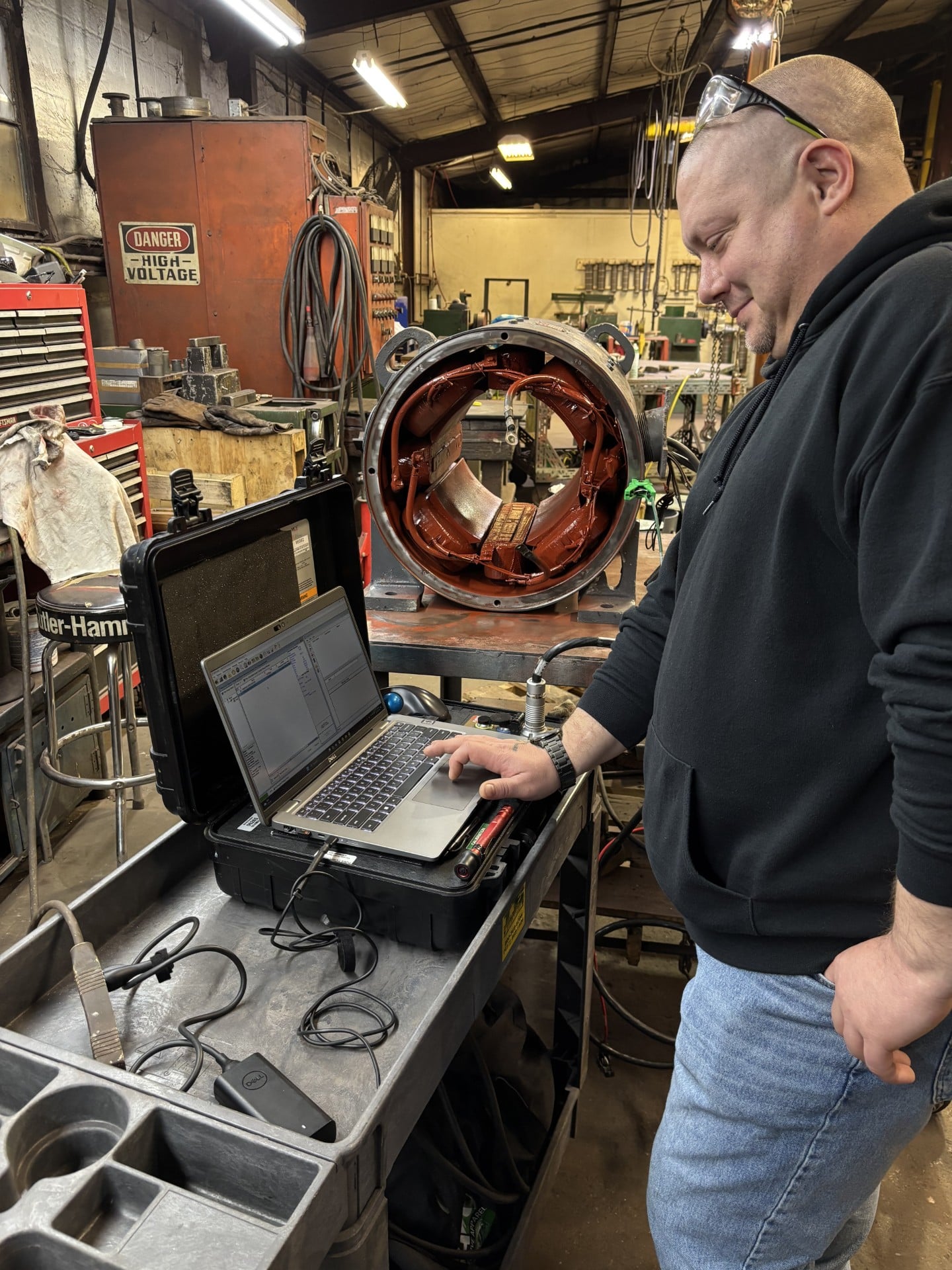
At Independent Electric, we can perform PdMA testing to assess electrical health or vibration analysis to diagnose mechanical problems.
Hearing unusual motor noise? Contact us for a professional assessment.